
















































































To appear in Perplexity answers, your site needs clear facts that its crawlers can read and cite. Web and e-commerce development must support that with structured data, which labels information for machines, and fast server responses. Blocking automated readers or hiding key details behind browser scripts keeps your business out of the answer box.
The most common mistake marketing teams make is treating answer-engine optimization as a copy rewrite. Adding conversational questions to thin pages will not fix the problem. Search crawlers check how brands and services connect, pull facts from tables, and favor claims they can verify over sales copy.
What’s Inside This Guide
- Aligning Real Business Goals with Generative Retrieval
- The Six-Stage Technical Roadmap for Answer-Engine Visibility
- Evaluating Discovery Channels in the Generative Search Era
- Engineering Answer-Ready Copy and Structured Page Layouts
- Key Performance Metrics and Monitoring Frequencies
- Costly Technical Missteps and Realistic Impact Windows
- Common Questions on Perplexity Search Optimization
- Collaborate with Prozco Branding on Modern Web Architecture
Aligning Real Business Goals with Generative Retrieval
Perplexity does more than rank pages for a list of ten blue links. Its indexing systems collect sources they can verify and use them to build answers in real time. Linked citation cards show readers where those claims came from.
Before working toward those citations, decide what your business needs from them:
- Target user intent: Identify the research questions prospects ask as they compare platforms or check a vendor’s specifications and implementation timelines.
- Entity verification: Use Schema.org vocabularies to spell out relationships across your site. These shared labels help AI systems connect your brand name to the services you sell.
- Direct attribution goals: Track how many people click through from AI answer cards. Organic search impressions alone will not tell you how those citations perform.
Buyers comparing service partners or product lines need quick answers to technical questions. Clear definitions and comparison tables give answer engines facts they can quote. Published pricing models also help readers assess an option without having to ask for basic details.
The Six-Stage Technical Roadmap for Answer-Engine Visibility
Preparing a site for answer engines takes changes to both its code and its content. Our engineering team follows this sequence to make pages readable by the systems that retrieve and cite them.
Video: Optimizing for Perplexity AI search in 2025, an SEO strategy guide from SEO Expert Insights.
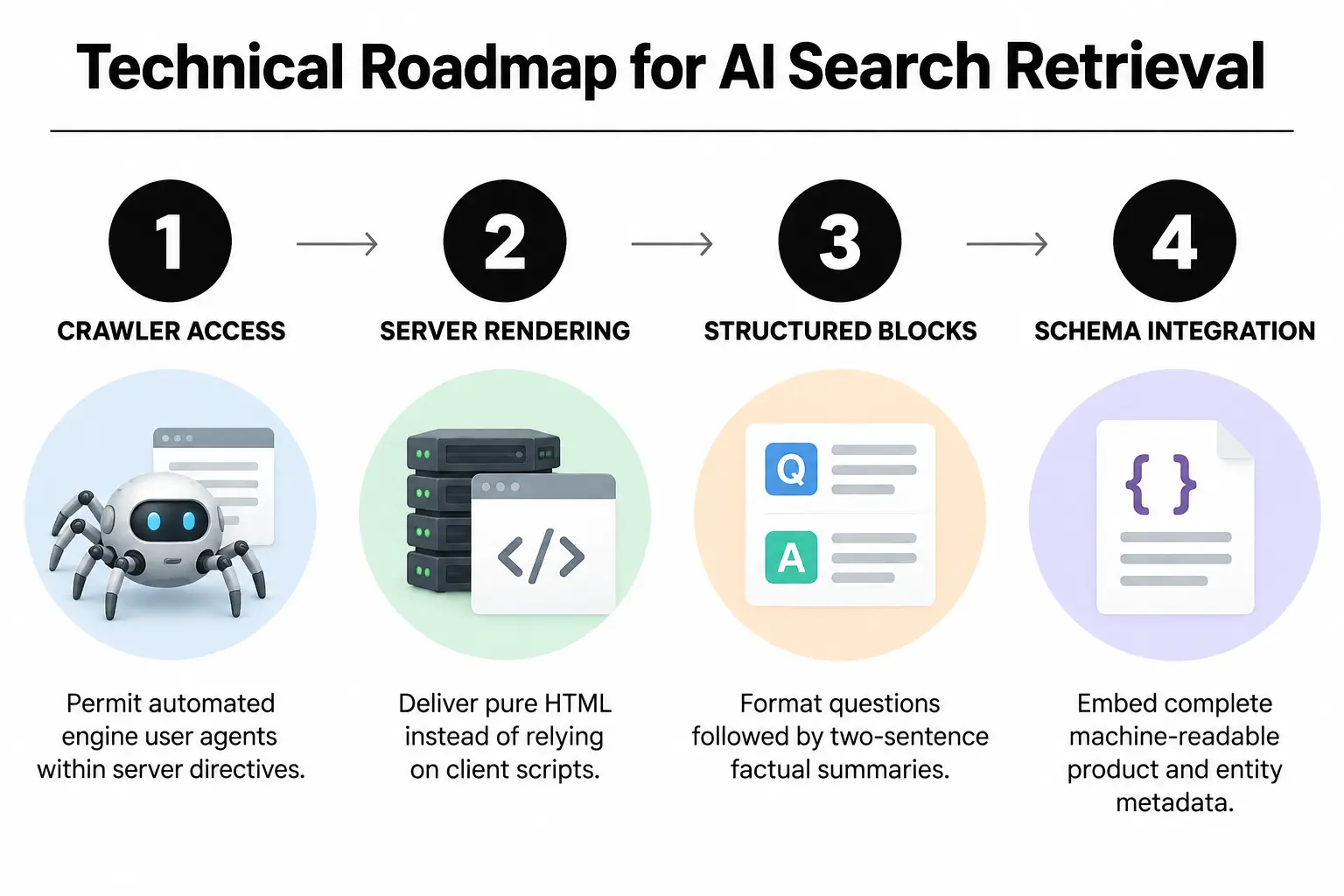
- Check crawler access: Confirm that your server settings and robots.txt crawl rules let PerplexityBot read page text. Cloudflare challenges and request limits should not stop it from reaching that content.
- Check reliance on browser scripts: Keep primary information readable without JavaScript having to assemble it in the browser. AI crawlers often miss text that only appears after those scripts run. Our web development work prioritizes HTML prepared in advance or generated on the server.
- Build clear question-and-answer blocks: Put each question in an HTML tag that identifies its role. Follow it directly with a two-sentence answer that makes sense on its own.
- Add complete product schema: For online stores, use nested structured data to describe prices and model availability alongside merchant details. Good e-commerce development keeps product records aligned with formats that machines can read.
- Fix slow responses and redirects: Remove chains of redirects and reduce the time your server takes to respond. Work on page speed optimization so crawlers can read the full response before their requests time out.
- Keep up with technical maintenance: Broken links and old scripts reduce trust in your site, as does outdated structured data. Regular website maintenance keeps those signals accurate as your pages and products change.
Following this sequence keeps your site readable for people and automated indexing systems alike.
Evaluating Discovery Channels in the Generative Search Era
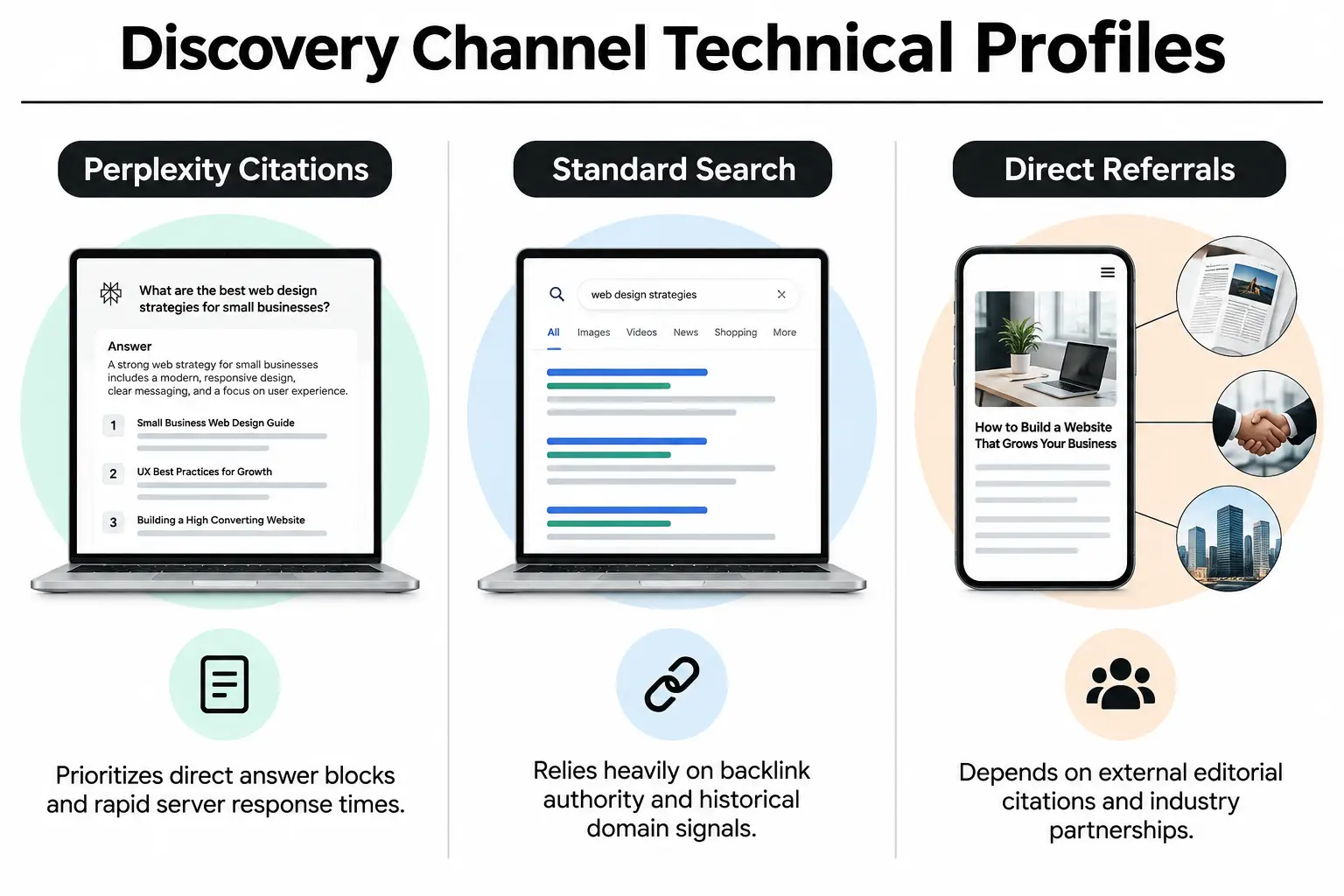
Building visibility across several search platforms protects your traffic when algorithms change. Each channel has a different role, so the engineering work and time needed will vary.
| Discovery Channel | Best Suited For | Engineering Effort | Time to Initial Results |
|---|---|---|---|
| Perplexity citations | Detailed research and B2B comparisons that require technical checks | Medium (needs meaningful HTML tags and plenty of facts) | 4 to 8 weeks |
| Traditional Google search | High-volume searches for specific sites and broad commercial terms | High (needs trusted backlinks and competitive content) | 12 to 24 weeks |
| Platform-specific stores | Direct product purchases through targeted retail storefronts | Medium (catalog upkeep and storefront design) | 2 to 6 weeks |
| Direct referral networks | Brand partnerships and mentions in press or industry publications | Low to medium (building relationships and sharing content) | 8 to 16 weeks |
Traditional search still brings in volume, while conversational engines send highly qualified referral traffic. People using these engines have already worked through the basic questions. They are looking for partners who can handle a specific implementation.
Engineering Answer-Ready Copy and Structured Page Layouts
Write direct statements with a clear subject and verb. Conversational models can extract these sentences more easily than long analogies or wordy sales pitches. Extra adjectives make the facts harder to separate from the promotion.

Give each key landing-page section a direct definition within its first thirty words. Support the text with comparison tables or numbered steps, using specific facts. For complex catalogs built through Magento development, put dimensions and materials in plain HTML tables. Turnaround times belong there too, rather than inside tabs that depend on scripts.
Technical standard: Perplexity favors facts it can extract over sales copy. Claims without support in structured data or agreement among factual sources rarely become cited snippets.
Readable code still needs a well-designed page around it. Our website redesign services help buyers who follow citation links find a polished site they can use. At Prozco Branding, we build interfaces that let automated systems read data quickly while guiding buyers toward a purchase or inquiry.
Key Performance Metrics and Monitoring Frequencies
Old ranking reports cannot fully measure performance in conversational search. An answer generated for one person on the spot does not have a fixed ranking position you can track.
Use these checks to see what is changing and how often to review it:
- AI referral traffic: Check your analytics weekly for visits referred by perplexity.ai and similar platforms. These records show which answer engines send people to your site.
- Citation frequency: Test prompts every two weeks across your top fifteen industry problems. Record whether your domain appears in the answer’s citation cards.
- Brand attribution: Search your brand name monthly and check that the answer lists your actual services. Watch for invented details or prices that are no longer current.
- Crawler requests in server logs: Review logs monthly to confirm PerplexityBot receives HTTP 200 responses, the code for a successful request, rather than rate limits or access errors.
Rising referral traffic alongside flat search impressions shows that the work is paying off. Focus on commercial interest from readers ready to act, rather than impression counts that look good in a report.
Costly Technical Missteps and Realistic Impact Windows
Growing brands often hide essential specifications behind downloadable PDFs, lead forms, or popups. Crawlers assembling quick answers will not download binary files or complete forms to inspect that information. Instead, they move to a competitor whose server provides the answers in readable HTML.
Neglecting mobile layouts is another common mistake. Although Perplexity retrieves content through servers, its evaluation process checks that mobile pages contain the same information. The guide to semantic HTML explains why accessible, native HTML elements hold up better than fragile script frameworks.
Expect meaningful changes to take eight to twelve weeks of ongoing technical work. Promises of overnight inclusion in AI answers are not credible. Search engines revisit pages periodically and rebuild their retrieval databases over time. Citation weights also change as a domain proves reliable.
Common Questions on Perplexity Search Optimization
How does Perplexity decide which websites to cite as sources?
Source selection depends on how much factual information a page contains and how clearly its HTML identifies that information. Authority on the topic and response speed also matter. Direct answers backed by structured data get cited more consistently than pages filled with vague sales claims.
Does custom headless web development help or hurt AI search indexing?
A headless setup separates content management from the site’s display layer. It can hurt indexing if browser scripts must run before the core text appears. Server-side rendering or static generation avoids that problem by preparing the HTML before delivery, giving AI crawlers readable pages without a long wait.
Can e-commerce product pages get cited directly in generative AI searches?
Yes, product pages often receive citations when people compare specifications or prices, or check compatibility. Product schema gives retrieval systems labeled data to read. Visible specification tables support those labels and make the same details available to shoppers.
How does Web and e-commerce development differ when designing for AI bots versus human shoppers?
Good web and e-commerce development serves both without sacrificing either. Meaningful HTML tags and logical headings help crawlers understand pages, while fast server responses let them retrieve the content. For shoppers arriving through citations, clear type and easy-to-use layouts make visible calls to action easier to follow.
Do I need to create a dedicated robots.txt rule for PerplexityBot?
Check your robots.txt file for broad wildcard rules that might block PerplexityBot by accident. Explicit permission lets the engine crawl your product directories and editorial content, including specification sheets, without encountering server-side access blocks.
Collaborate with Prozco Branding on Modern Web Architecture
Preparing a site for conversational search takes careful technical work, not a fresh layer of copy. At Prozco Branding, we build digital storefronts and custom publishing portals. Our enterprise platforms follow the same approach: make the information clear to the systems retrieving it.
We work directly with Los Angeles businesses to revise site architecture and rebuild older templates with clean structured data. That work supports high-traffic stores as well as enterprise catalogs. The goal is to keep those sites readable as search algorithms change.
For a technical roadmap to prepare your site for AI search, contact our team.