

















































































Search engine optimization depends on how easily search crawlers can read your website. Removing bloated scripts and needless markup helps crawlers catalog content faster. That gives your site the technical foundation it needs to hold organic rankings over time.
Messy code makes that work harder. Search crawlers have limited time and resources for each site. Broken tags and deeply nested scripts use up that allowance before crawlers can understand what your business offers.
What’s Inside This Guide
- The Anatomy of a Clean Document Object Model
- How Search Bots Traverse Semantic Markup
- Lightweight Custom Engineering Versus Heavy Page Builders
- Structural Code Strategies and Their Practical Trade-offs
- Technical Implementations for Different Business Scales
- Long-Term Code Hygiene and Performance Monitoring
- Search Bots and Code Architecture Queries
- Building Your High-Performance Foundation in California
The Anatomy of a Clean Document Object Model
Clean code gives every line of markup a clear job. The document object model, or DOM, is the browser’s tree of page elements. Using meaningful HTML5 tags instead of extra styling wrappers makes the relationships between headings, copy and data clear.
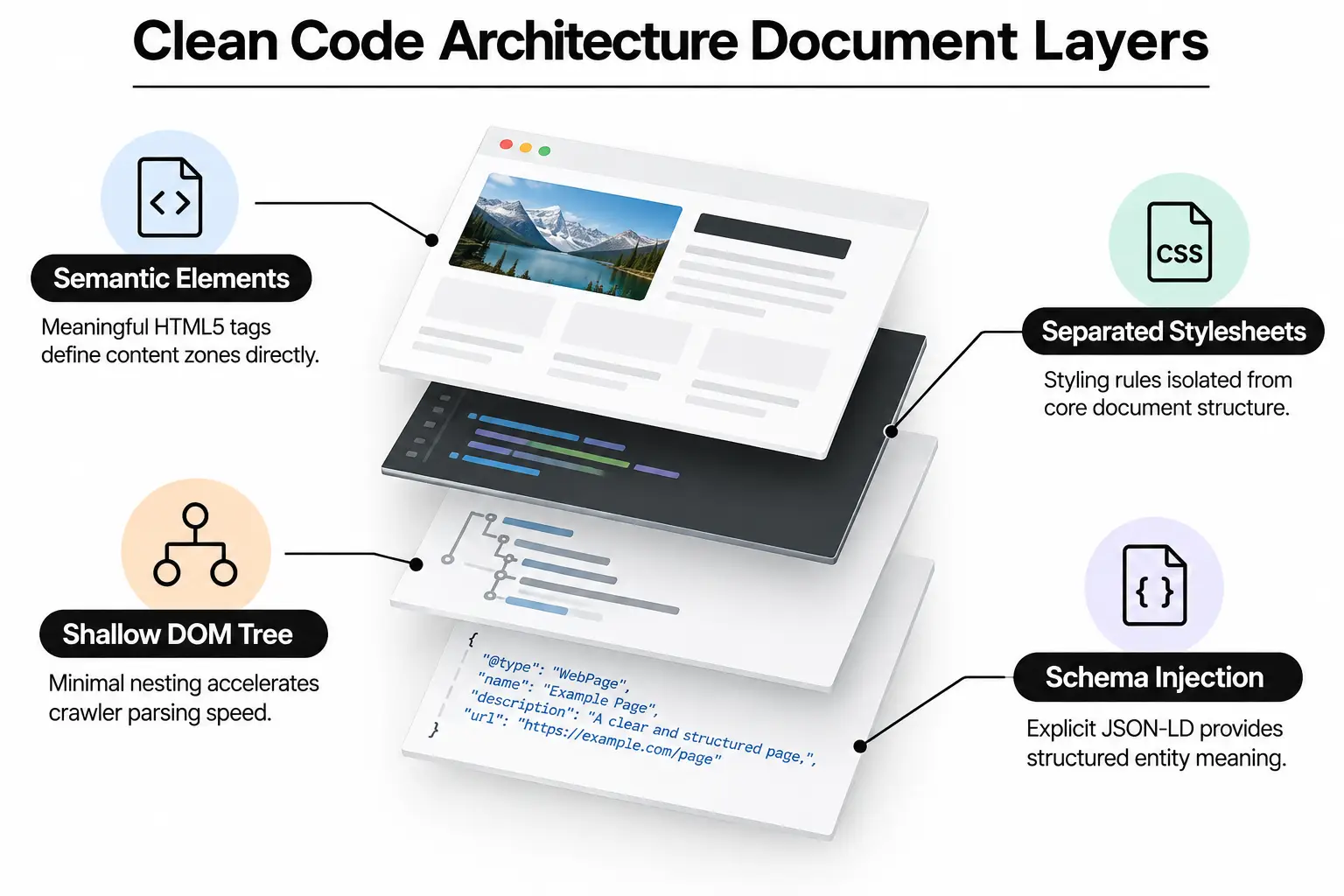
- Meaningful HTML: Tags like article, nav, header and section explain what each part of a page does without relying on generic containers.
- Separate files: JavaScript handles behavior, CSS handles appearance, and HTML holds content. Each belongs in a dedicated file rather than tangled inline blocks.
- A shallow DOM: Fewer nested elements mean less processing work when browsers and crawlers build the page layout.
- Structured data: JSON-LD blocks, a machine-readable data format, sit in source files to identify the brand and its location details.
With these layers in place, browsers can read and display pages with less strain. At Prozco Branding, our work as a branding agency connects technical architecture with interface and user experience design. The page needs to look right and remain readable to machines.
How Search Bots Traverse Semantic Markup
Search engines first discover page addresses and download source files. They then run scripts and update their search indexes. As Google Search Central explains in its crawling documentation, automated crawlers have limited resources for each host.
Video: Episode 3: Technical SEO & The 97/100 Lighthouse Score (mfmd – Digital Marketing Services)
Deeply nested markup makes crawlers spend processing time on empty containers and scripts the site no longer uses. Clean architecture gives bots lightweight text they can read right away. They can understand its context and find internal links without waiting for scripts to render the page.
Architecture rule: Crawlers read code rather than browse like people, so clear structure always matters more for discovery than visual tricks.
The Hidden Crawl Budget Bottleneck
Businesses often invest in organic search campaigns while overlooking crawl traps in their code. JavaScript that runs in the browser can delay access to text. Google’s Web Rendering Service may then queue those pages for another evaluation days later.
Server-rendered HTML, which arrives with the content already built, removes that delay. Bots can read heading levels and product details on the first request. They can also follow navigation links deeper into your site instead of stopping at the first page.
Lightweight Custom Engineering Versus Heavy Page Builders
California businesses often weigh drag-and-drop builders against purpose-built code. Visual builders make early mockups quick to produce, but their extra scripts add weight to the finished site. That weight compromises organic search performance after the site goes live.
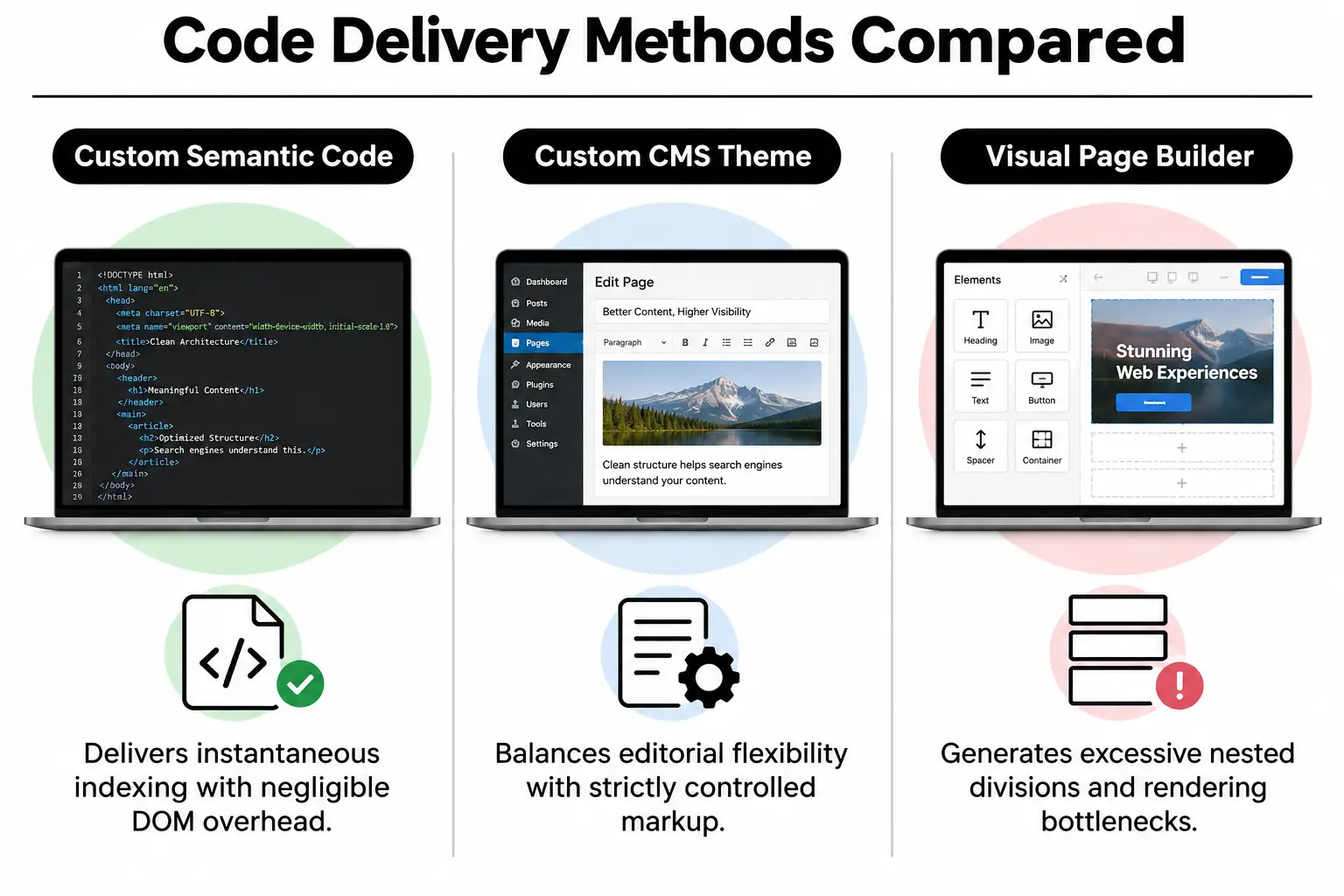
| Engineering option | HTML-to-content ratio | Crawler rendering strain | Maintenance effort | Cost tier |
|---|---|---|---|---|
| Hand-written semantic code | Very high (clean text) | Almost no rendering delay | Scheduled source updates | $$$ |
| Modern custom CMS theme | High (structured output) | Little extra rendering work | Routine security updates | $$ |
| Visual drag-and-drop builder | Low (excess markup) | Heavy browser processing | Frequent plugin conflicts | $ |
Clean code in your corporate blog design keeps publishing lightweight as you add articles. Each post gives search engines content they can index easily, rather than a bulky set of styling rules to work through first.
Structural Code Strategies and Their Practical Trade-offs
Your engineering model affects both how quickly you can publish and how efficiently search engines can index pages. The practical choice starts with how your site delivers markup to a visitor’s device.
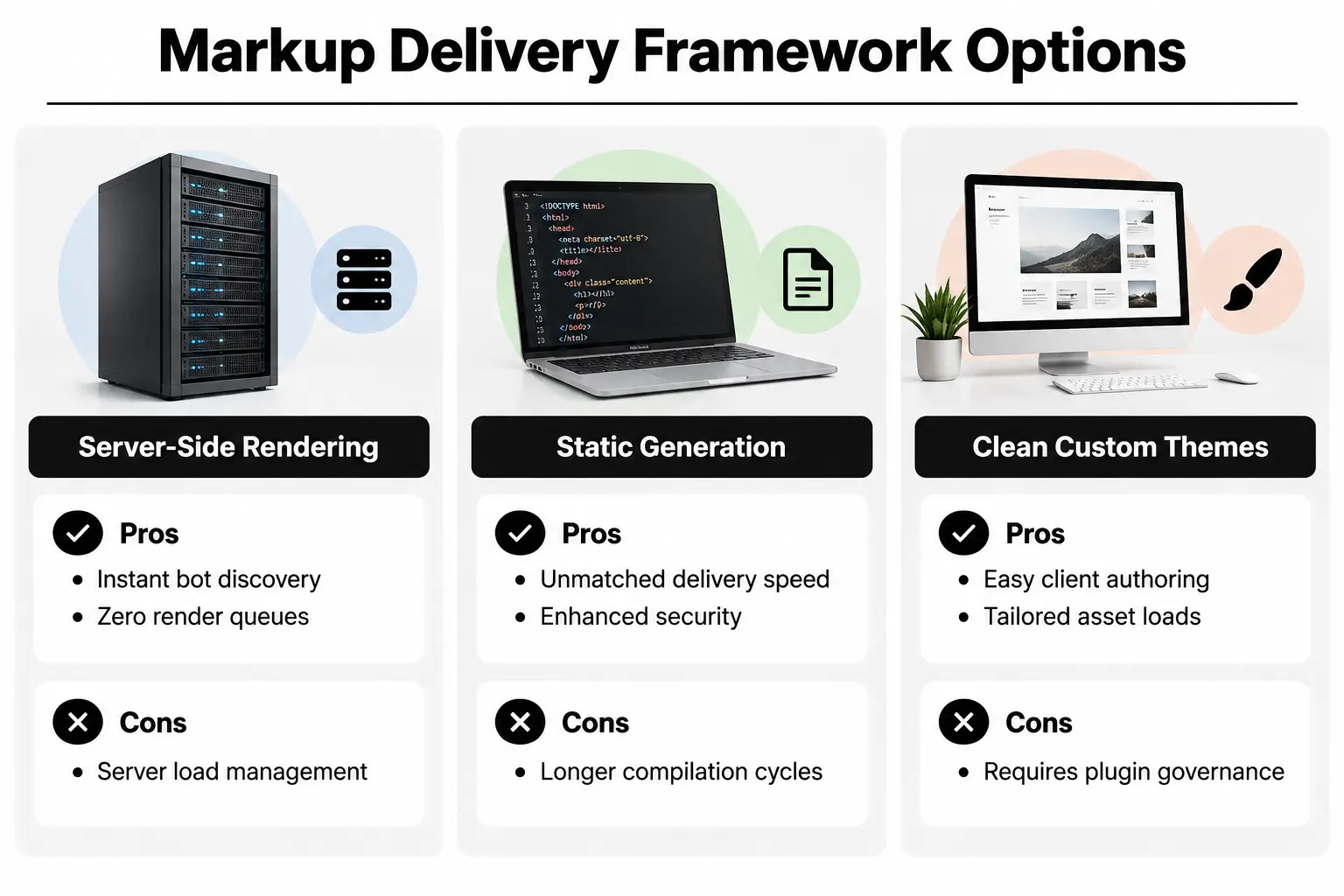
- Server-side rendered (SSR) HTML: The host sends a complete page. Pro: Immediate indexing with no rendering queue delays for bots. Con: Needs dependable server infrastructure and carefully configured caching, which stores copies for reuse.
- Static site generation (SSG): Builds ready-to-serve files from Markdown text and templates before anyone requests them. Pro: Unmatched delivery speed and security. Con: Large product catalogs with frequent inventory changes take longer to rebuild.
- Lightweight CMS frameworks: Use carefully written themes on custom WordPress websites, with a content management system for editing. Pro: Flexible publishing tools with close control over templates. Con: Third-party plugins need checks to keep extra files from piling up.
- Mobile formats: Options such as accelerated mobile pages suit content that needs to load immediately. Pro: Much less data to send to mobile devices. Con: Strict markup rules limit what you can use.
Choosing the right balance helps regional businesses grow their sites without losing technical performance as their catalogs expand.
Technical Implementations for Different Business Scales
The right code structure depends on the size and scope of your business. A growing San Diego brand has different needs from an established online store serving customers across California.
| Business situation | Recommended architecture | Primary risk | Maintenance action |
|---|---|---|---|
| Local service business | Lean custom WordPress theme | Too many plugins adding weight | Remove unused files quarterly |
| B2B lead generation | Static pages with a separate content management system | Delays from form-routing scripts | Monitor DOM size |
| Online store with many product codes | Hybrid SSR with cached copies near users | Product filters creating crawl traps | Audit preferred-page and indexing tags |
Practical check: Before adding a front-end framework or interactive widget, check that your main offer remains visible in the raw source with JavaScript disabled.
Clean code also helps the sales process. Faster responses support conversion rate optimization, the work of turning more visits into actions. They reduce abandoned checkouts and make forms less tiring to complete on mobile devices.
Long-Term Code Hygiene and Performance Monitoring
Code gets cluttered as teams launch campaigns and install tracking scripts. Layout changes add to the problem. Without regular technical oversight, the performance gains you started with can disappear within months.
Regular engineering reviews protect search visibility. The Core Web Vitals guidelines on web.dev give you measurable targets for response delays and layout stability, or how much content moves while loading.
Essential Maintenance Cadence
- Remove unused scripts monthly: Delete old marketing tags and tracking code left behind by finished promotions.
- Audit the DOM quarterly: Check page layouts to keep nested elements under thirty-two levels deep.
- Clean up CSS: Remove unused styling classes in line with W3C HTML standards.
- Schedule server checks: Confirm that Brotli or Gzip, which compress files for transfer, stays active wherever your site delivers files.
Regular website maintenance keeps pages fast and dependable throughout the year. It also keeps the site straightforward for search engines to read.
Search Bots and Code Architecture Queries
Does minifying CSS and JavaScript directly change search positions?
Minification shrinks source files by removing unnecessary spaces, line breaks and comments. It is not a direct ranking signal. The smaller files do take less time to download, though, and speed up indexing cycles.
How does clean code improve conversion rate optimization?
Clean templates remove delays in displaying the page, so action buttons and checkout screens load immediately. Lead forms load immediately too. With no lag between a user’s input and the site’s response, fewer visitors leave and more complete transactions.
Why do custom WordPress themes perform better than pre-made templates?
Marketplace themes try to suit many businesses at once. They include dozens of unused features, heavy slider scripts and multiple font libraries. A custom theme contains only the markup your company needs, keeping the page structure small and easy to read.
Can messy code cause rendering errors during indexing?
Yes. Unclosed HTML elements and script errors often stop the browser from reading the page structure correctly. Crawlers that cannot interpret tags may stop reading partway through a page or miss important internal links entirely.
What role does semantic HTML play in local California searches?
Meaningful HTML tags distinguish business details from text repeated across the site. They help search engines identify addresses and hours, along with service menus. That clarity makes regional signals clear in competitive markets from Los Angeles to the Bay Area.
Building Your High-Performance Foundation in California
A sound technical foundation helps organic leaders hold their position while other sites drop after major search updates. At Prozco Branding, we pair search engine optimization with lightweight engineering. Use this checklist to assess where your current setup stands:
- Text appears in the source code without needing external JavaScript to process it.
- The page structure stays shallow, without layers of unnecessary wrappers.
- Essential metadata and JSON-LD structured data arrive in the first server response.
- Images, stylesheets and scripts arrive compressed through modern delivery networks.
- Templates adapt to screen sizes without content shifting as the page loads.
For more technical context, read our search optimization articles. To assess your site’s architecture, contact Prozco Branding.