

















































































Full-stack web and e-commerce development covers both the pages customers use and the systems behind them. For Southern California businesses, that means building the interface alongside the servers, databases and rules that process each transaction.
For a growing company, the safest starting point is to plan those parts together. Treating the customer interface and backend as separate design or database projects leaves gaps that can be expensive to fix.
Your sales model changes what you need. Selling fifteen custom products on subscription calls for different database relationships than managing twenty thousand inventory units with wholesale pricing tiers. Understanding how those layers connect helps you spend where it protects revenue, rather than paying to fix structural problems six months later.
What’s Inside This Guide
- The Operational Risk of Fragmented Technical Architecture
- Selecting an Architectural Base: Monolithic vs Headless Systems
- Matching Technical Engines to Commercial Operations
- Unifying Payment Gateways, ERPs, and User Data
- Engineering Milestones to Keep Product Builds on Track
- Capital Allocation: Balancing Infrastructure and Growth
- Direct Technical Questions from Company Operators
- Planning Your Infrastructure with Prozco Branding
The Operational Risk of Fragmented Technical Architecture
Problems start when teams treat the customer interface and the code behind it as disconnected projects. A design agency might build attractive pages that load slowly because database requests strain the server. Meanwhile, a backend engineer might create complex database tables without giving marketing staff a usable content editor.

Splitting engineering this way turns routine updates into expensive development work. Seasonal promotions need custom patches, while inventory changes leave stored page data out of sync. Checkouts can break when traffic spikes. Good responsive web design needs reliable server connections to avoid these failures.
Architecture check: If a basic checkout or product change needs manual edits to both a page template and database structure, those layers are too tightly tied together.
Businesses competing for Los Angeles customers cannot afford a platform that freezes under real order volumes. Clear responsibility for the whole system helps protect the money you spend acquiring customers. Before committing to a platform, you can schedule an audit with our engineering team for an objective review of your site’s code.
Selecting an Architectural Base: Monolithic vs Headless Systems
Start by deciding how closely your pages should connect to the rules that run your business. Traditional coupled builds link page templates directly to the application database. Decoupled systems use application programming interfaces (APIs), connections that let software exchange data, to send content to separate customer-facing interfaces.
Video: TedxRio explains full-stack architecture and a development roadmap in this 2025 series.
Comparing Common Platform Foundations
| Platform type | Suggested starting point | What to watch |
|---|---|---|
| All-in-one content management system (CMS) | Catalogs under 1,000 stock keeping units (SKUs), with content published in one place | Unchecked third-party plugins adding unnecessary database records |
| Managed e-commerce platform | Direct-to-consumer stores that need standard checkout flows | Transaction fees and limits on API requests |
| Custom headless build with a separate front end | High-volume brands selling across mobile and web channels | Ongoing upkeep across separate hosting systems |
Brands that publish a lot of content alongside their store can use custom WordPress websites to simplify admin work without extra API connections. Fast-selling consumer goods may justify managed platforms instead. Our Shopify development work lets businesses leave server scaling to the platform during flash promotions.
Matching Technical Engines to Commercial Operations
Choose your software around how the business runs, not how a demo looks. Order volume and inventory turnover matter, as do your team’s skills. Those needs determine whether standard frameworks will work or you need a custom application built in Node.js or Python.
| Business model | Recommended choice | Avoid |
|---|---|---|
| Business-to-business sales with custom pricing | Enterprise frameworks that control access by account tier | Basic hosted platforms without custom business account rules |
| Retail across multiple sales channels | A central database with webhooks that send inventory updates as changes happen | Spreadsheet uploads that sync disconnected points of sale in batches |
| Editorial and publishing | Structured content systems with caching that stores reusable content in small pieces | Networks of small, separate services for simple content layouts |
| Large enterprise catalogs | Dedicated platforms with relational databases that connect related records | Shared hosting with catalog tables that lack indexes for fast lookups |
Operational rule: Don’t build small custom backend services for work an established open-source framework already handles with proven security patches.
Companies with large product ranges and complex warehouse routing often use Magento development. Platforms like this give you detailed control over business resources. That control depends on engineers knowing how to cache data, keeping reusable copies available without serving outdated information.
Unifying Payment Gateways, ERPs, and User Data
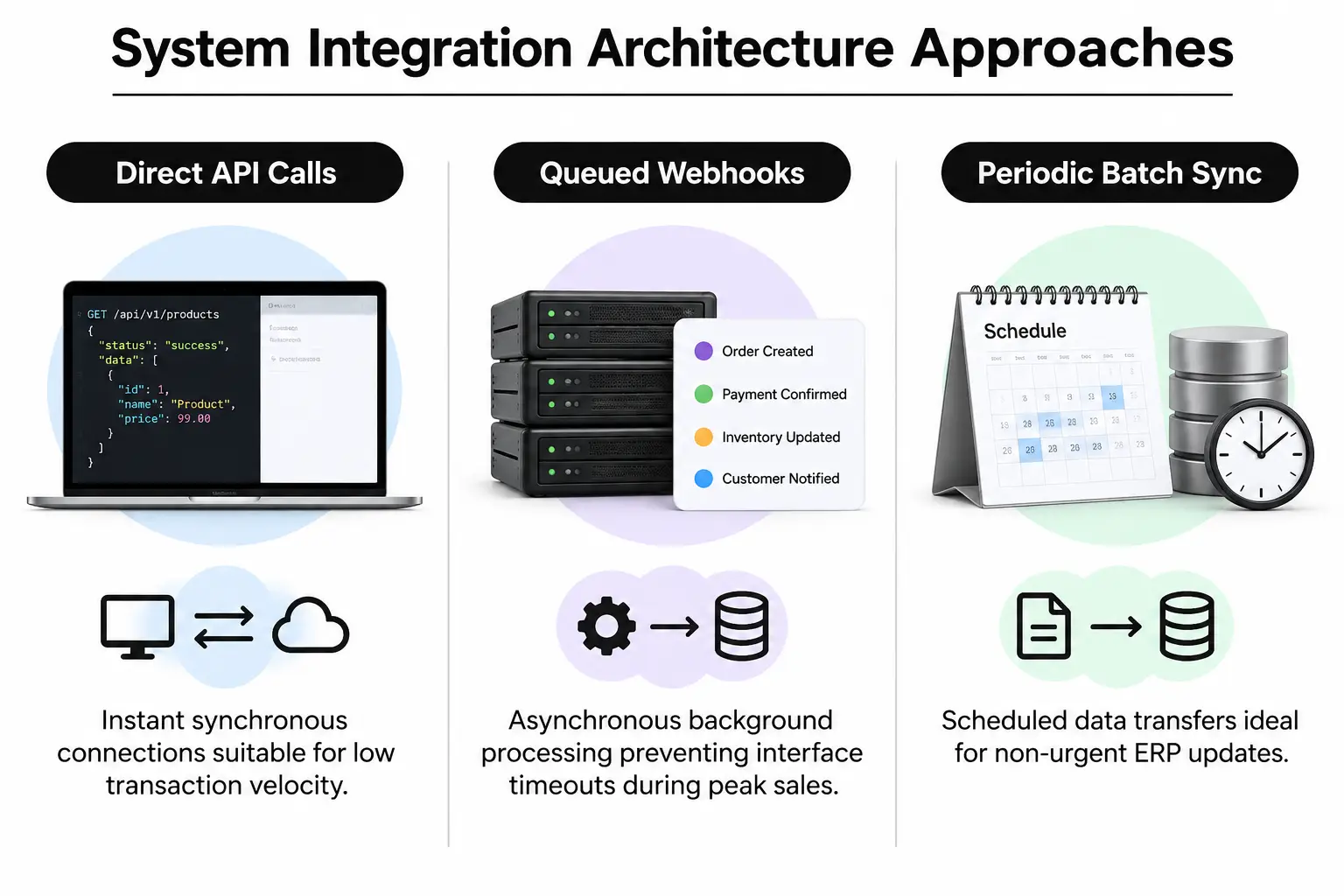
External connections can fail even when your pages feel fast. Enterprise resource planning (ERP) software manages business resources, but errors in its sync or your payment gateway can silently drop orders. Connecting these services requires clear timeout settings and reliable queues that hold tasks until they can run.
| Connection | How data moves | What to test | Intended result |
|---|---|---|---|
| Payment processing | Payment details become tokens, then the server checks the payment service’s response | Expired sessions and customers clicking checkout twice | No lost carts and full compliance with Payment Card Industry (PCI) data security standards |
| Warehouse inventory | Background workers process webhook updates from a queue | Many requests arriving together during a simulated promotion | Prevent overselling during busy sales periods |
| Customer relationship management (CRM) | Customer actions trigger tracking scripts that run in the background | Valid custom field data and consent opt-ins | Reliable audience groups without slowing the browser |
Following web standards helps protect working code from breaking as browsers change. Careful WordPress development, paired with modern server-side scripts, lets growing businesses coordinate these connections. Customers can keep using the site while the systems behind it exchange data.
Engineering Milestones to Keep Product Builds on Track
Technical teams work in stages to control costs and keep sites fast. Skipping database planning to start on page layouts is the most common cause of missed launch dates.
- Plan the database: Map the records you need, their fields and how they relate in PostgreSQL or MySQL before building interface components.
- Define API requests and responses: Specify what data each connection accepts and returns. Check incoming data against application security guidance.
- Build the interface: Make components accessible and quick to load. Use structured CSS frameworks to keep page styling organized.
- Connect business rules and services: Link interface actions to payment notifications and email queues, including transaction receipts.
- Test under peak load: Simulate customer transactions to find slow database requests and memory leaks, where software holds memory it no longer needs.
Deployment check: Never change a live database structure while customers are active without a verified backup from a known time that you can restore.
Working through these stages reduces technical debt, the future repair work created by shortcuts today. For projects with demanding sales goals, use tested conversion methods alongside the engineering work. These six conversion tactics used by Los Angeles brands help turn code changes into progress through checkout.
Capital Allocation: Balancing Infrastructure and Growth
Base your budget on how long the platform will serve you, rather than its lowest upfront price. Cheap themes often leave enough repair work to force a full rebuild within twelve months.
| Budget level | What to prioritise | What to question |
|---|---|---|
| Early-stage business ($) | Standard platform setups with clear interfaces and stable hosting | Custom animations that slow pages and consume the budget |
| Growing operations ($$) | Custom checkout rules, plus database indexes and automated tests for transactions | Large all-in-one systems that need full-time internal maintenance teams |
| Enterprise volume ($$$) | Cloud server groups built to stay available, custom ERP connections, and cached content near users | Closed-source platforms that charge royalties on gross revenue |
Dependable architecture is where the lasting savings come from. Investing in the whole system protects long-term margins. Stable platforms remove the need for emergency patches at midnight and reduce the work needed to bring new developers onto the project.
Direct Technical Questions from Company Operators
What does a full-stack engineer deliver that a frontend developer cannot?
Full-stack engineers work on both the customer interface and the server-side systems that manage data. Frontend specialists focus on what users see and interact with. Full-stack work also covers database queries and cloud server setup, plus API connections and data security wherever transactions cross between systems.
How do we decide between custom engineering and hosted solutions?
Hosted platforms suit standard retail sales that don’t need custom quotes or connections to older accounting systems. Custom engineering gives you more control when your subscription rules are unique. Complex pricing tables or close links to ERP software can also justify that extra work.
Why does database indexing matter for growing commercial websites?
Database indexes work like a catalog lookup, helping servers find a record without reading every row for each search. Without them, requests get slower as order histories and customer accounts grow. That extra database work slows checkout in the customer’s browser.
What security protocols must be prioritized during development?
Use parameterized SQL queries to keep user input from becoming database commands. Strict Content Security Policies limit allowed browser content, while bcrypt or Argon2 hashing protects passwords. Encrypted payment tokens replace sensitive card details. Consult browser security documentation to check that browser-side login tokens follow current secure cookie standards.
Planning Your Infrastructure with Prozco Branding
Reliable web products need engineering experience grounded in how a business actually runs. At Prozco Branding, we build web platforms for businesses across Los Angeles. We design them to handle growth and turn visitors into steady sales.
Before commissioning your next build, check these requirements with your team:
- Catalog size: Confirm whether your SKU count needs custom database indexes or the standard data structures a hosted platform provides.
- Outside connections: List every third-party service, including warehouse software and the webhooks that send updates to your CRM.
- Speed targets: Set required desktop and mobile thresholds for Core Web Vitals, Google’s measures of page loading and usability.
- Maintenance responsibility: Decide who handles security patches and server updates, including the software libraries your application depends on.
- Data portability: Confirm that your business keeps full ownership of customer databases and its proprietary code.
Contact Prozco Branding to schedule a technical consultation about your company’s next web platform.