

















































































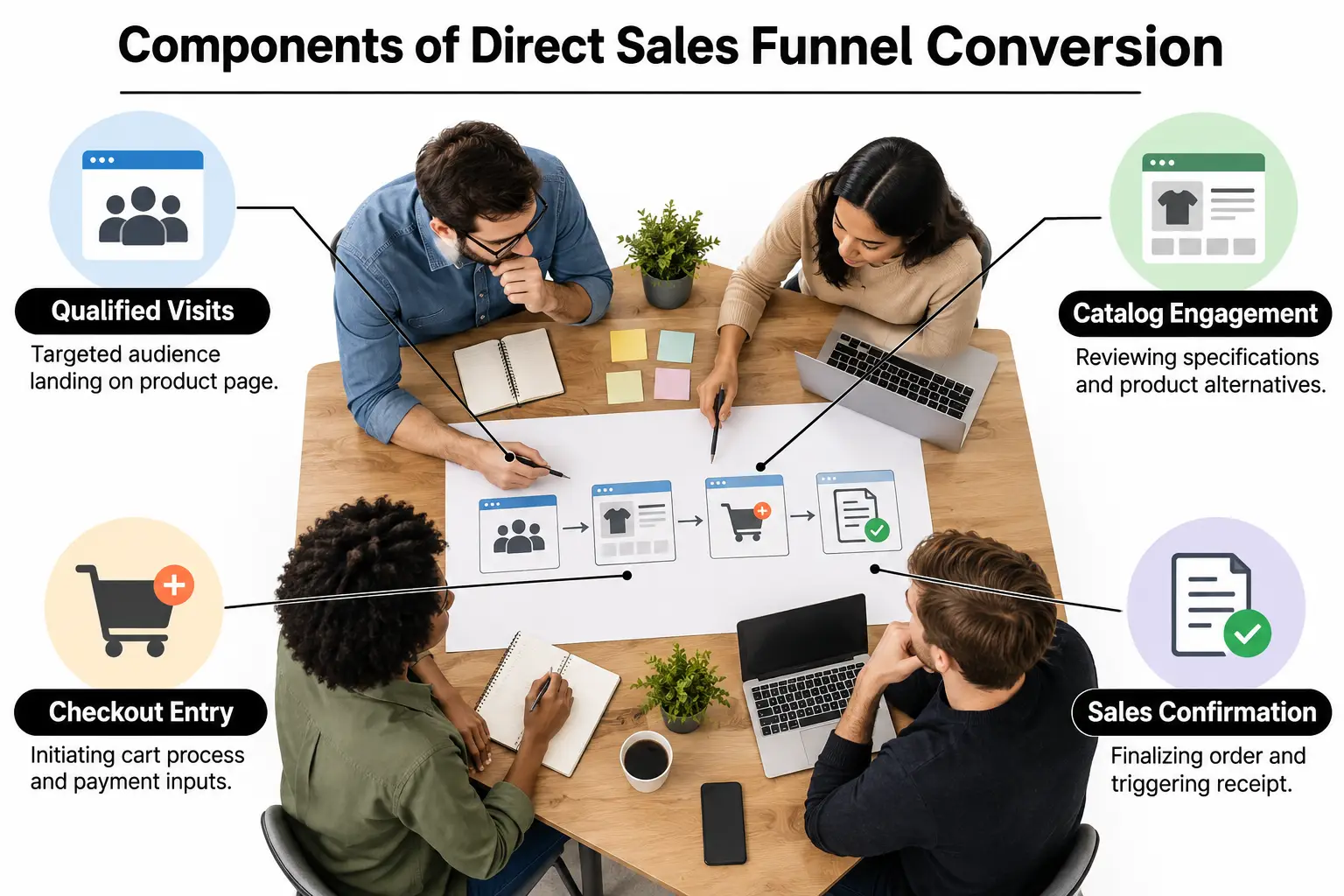
Conversion rate optimization helps you turn more website visits into direct sales actions. Your conversion rate is the share of qualified visitors who take the next step, such as buying a product. Depending on your sales process, that step might instead be requesting an enterprise quote or booking a consultation.
A falling rate deserves a closer look, not an immediate overhaul. Before changing your site, check whether traffic volume, campaign sources or the products people viewed have changed.
Buyers need a clear path from their first visit to a completed purchase. Unanswered product questions and checkout problems can stall revenue even as visitor counts rise. More traffic cannot fix a sales page that leaves people unsure what to do next.
What’s Inside This Guide
- Understanding Direct Sales Conversion Metrics
- The Conversion Rate Formula and Practical Calculation
- Evaluating Performance Across Channels and Goals
- Setting Up Analytics and Attribution Tools
- Core Levers That Move Direct Sales Conversion
- Reporting Cadence and Actionable Decision Rules
- Direct Sales Conversion Inquiries Answered
- Strengthening Your Direct Sales Funnel in California
Understanding Direct Sales Conversion Metrics
Think of this rate as a measure of sales efficiency: how many visits end with your chosen sales action? A direct-to-consumer brand usually counts finished orders. A business-to-business supplier might count submitted purchase agreements or scheduled sales calls. Choose the milestone that fits how your business sells.
That percentage cannot tell you how satisfied customers are or whether they will buy again. Nor does it show product margins. Selling inventory below cost can produce a high conversion rate while losing money. Expensive industrial purchases may convert less often yet bring in substantial gross profit.
For direct sales, studying visitor behavior works alongside search engine optimization. Product pages need visitors who intend to buy, not just people browsing out of curiosity. Thoughtful corporate blog design also gives buyers room to learn before checkout. That helps filter out inquiries from people whose needs do not match your offer.
The Conversion Rate Formula and Practical Calculation
Divide completed sales actions by unique sessions, or visits, over the same period. Then multiply the result by 100 to express it as a percentage. Use the same date range for both figures.
Video: WebFX explains conversion optimization basics and practical tips
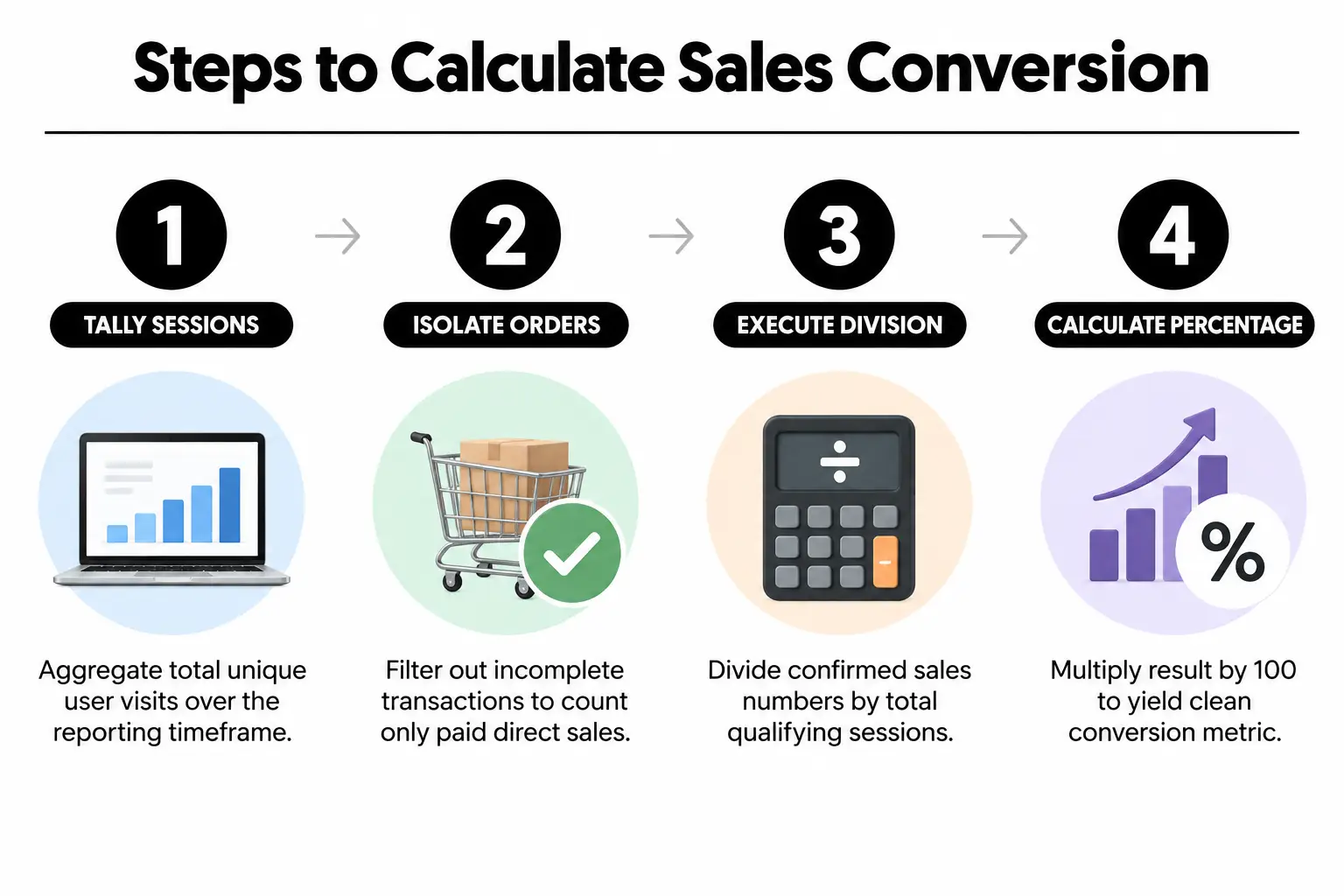
Consider a hypothetical California equipment supplier with 10,000 site visits in one calendar month. Suppose those visits produce 250 confirmed purchases. These are example figures, not a benchmark for your business. Put the completed purchases above the visit count, then calculate the percentage:
(250 conversions / 10,000 sessions) x 100 gives the share of visits that ended in a sale.
Keep smaller actions, often called micro-conversions, separate from completed payments. Combining newsletter signups or catalog downloads with purchases makes the result useless for revenue planning. Track each stage in its own column. Downloading a technical spec sheet shows interest, but only a finalized invoice represents a closed sale.
On custom sites, including custom WordPress builds, tracking scripts should run only after the payment gateway confirms payment. Check that setup before trusting the totals. Counting checkout-button clicks instead of visits to confirmation pages inflates your rate and gives you a false basis for sales forecasts.
Evaluating Performance Across Channels and Goals
No single rate tells every business it is doing well. A thirty-dollar impulse purchase has little in common with a manufacturing order worth thousands. Your starting point depends on how ready customers are to buy, how they respond to the price and where they found you.
Paid search visitors often buy at different rates from organic search visitors or direct referrals. Someone searching for an exact model number shows urgent buying intent. Someone following a social media image may still be browsing. Separate channel goals help show whether your conversion testing addresses website problems or a mismatch between the audience and offer.
Location and fulfillment matter too. California businesses may serve buyers around Los Angeles shipping hubs as well as agricultural centers in the Central Valley. Those buyers need clear delivery estimates and tax information for their location. Missing details can be enough to stop a purchase at checkout.
Setting Up Analytics and Attribution Tools
Clean tracking gives you a reliable basis for testing. Double-counted transactions or missing mobile purchases will lead you to the wrong conclusions. Direct sales teams typically combine site analytics with tools that show visitor behavior and manage tracking tags, the code used to record actions.
- Server-side tagging: Records events through a server rather than relying only on the browser. Setups using platforms such as Google Analytics 4 help bypass browser ad-blockers and capture purchase events.
- Heatmaps and session playback: Tools such as Microsoft Clarity or Hotjar show where buyers click and get stuck, including navigation problems or broken layouts.
- Form and checkout tracking: Dedicated scripts identify the exact form field where prospective buyers leave without finishing.
- Infrastructure monitoring: Performance tools check how quickly pages display on mobile, with accelerated mobile pages supporting fast catalog browsing.
Routine website maintenance keeps tracking code working after platform updates. Missing events deserve a technical check before you treat them as lost sales. Review your site diagnostics, or reach out to Prozco Branding so we can audit the setup.
Core Levers That Move Direct Sales Conversion
Guessing which button color will sell more gets you little useful information. Start by finding where buyers hesitate, then work out what makes that step difficult. Each change should address a specific obstacle in the sales process, rather than a design preference.
| Change to Test | What It Changes in the Sales Process | Work Required |
|---|---|---|
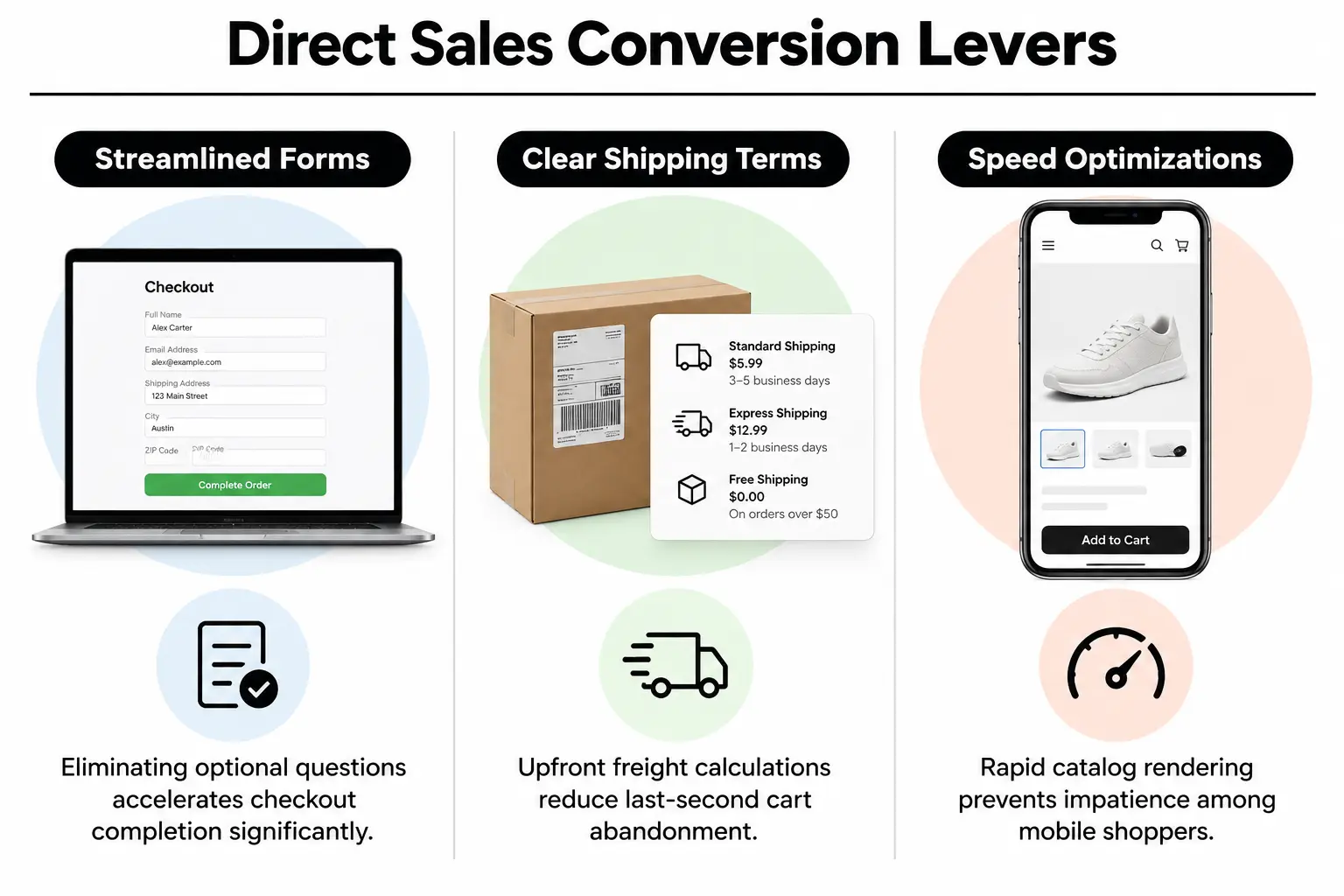
| Fewer checkout steps | Removes unnecessary account requirements and cuts the number of form fields | Moderate |
| A clearer product offer | Replaces vague slogans with specific product details and purchase terms | Low |
| Mobile layout improvements | Makes controls easier to reach and tap accurately, with properly aligned layouts | High |
| Faster page loading | Cuts delays on image-heavy product galleries and checkout pages | Moderate |
| More payment methods | Adds digital wallets so buyers do not have to type their card details | Low |
Checkout research from the Baymard Institute identifies complicated checkout flows as a leading reason for abandoned carts. Technical fixes matter as well as simpler forms. Work on page speed helps prevent buyers from leaving while pages load during busy traffic periods.
Clear layouts depend on thoughtful interface and user experience design. Readable type and consistent contrast should follow the web accessibility guidelines. Keep shipping details visible too. Buyers should not have to pause an order to hunt for information they need to make the purchase.
Reporting Cadence and Actionable Decision Rules
Daily reviews can turn small, random changes into unnecessary alarm. A review every two weeks or each month gives direct sales teams a more useful schedule. It also gives transactions time to accumulate, so decisions rest on enough data rather than a handful of visits.
Read conversion alongside average order value (AOV) and customer acquisition cost (CAC), the cost of gaining a customer. Heavy couponing can raise conversion while lowering order values enough to hurt net sales revenue. A steady rate with higher order volume, by contrast, shows genuine growth.
Reality check: Do not call a test winner until the original and changed versions both have enough completed transactions across weekdays and weekends.
Reports for leadership should support a decision, not defend a visual preference. Describe the obstacle and the change you tested, then show what happened to completed transactions. Finish with a clear recommendation on whether to keep the change across the site.
Direct Sales Conversion Inquiries Answered
What is the difference between direct sales conversion and general website conversion?
Direct sales conversion counts completed transactions that bring in revenue. General website conversion can count any action you want a visitor to take. Newsletter signups and whitepaper downloads qualify, as do social shares, even though none requires a financial commitment.
How much traffic do I need before conversion rate optimization makes sense?
Formal split tests, which compare two versions, need several hundred conversions a month for statistically confident results. Smaller sites can still improve without waiting for that volume. Start with observed problems: fix confusing navigation and broken links, and shorten inquiry forms where possible.
Can high search traffic decrease our conversion percentage?
Yes, broad or poorly targeted traffic often brings the overall rate down. Campaigns may attract people who have no need for what you sell. Visits then rise without a matching increase in orders, so a smaller share of the total converts.
How do mobile conversion rates compare to desktop for direct sales?
Mobile rates often fall below desktop rates. Small screens make forms harder to use and can heighten security concerns at checkout. Simpler forms and one-tap mobile payments help close that gap by making it easier to finish a purchase on a phone.
Does redesigning a website immediately improve conversion rates?
Not automatically. Moving familiar navigation can confuse returning customers and temporarily reduce purchases. Base changes on user research and measured results, rather than appearance alone. A fresh design needs to solve a buying problem before you can expect it to improve sales.
Strengthening Your Direct Sales Funnel in California
At Prozco Branding, we help California businesses build direct sales websites that connect their marketing with the buying process. Our work supports growing direct-to-consumer brands as well as established commercial distributors. Improving these sales channels takes careful analysis and testing, with web development and digital marketing working toward the same goals.
We pair targeted search marketing with ongoing improvements to how people use your site. Each engagement starts with clear timelines and a defined way to credit sales to marketing activity, plus milestones grounded in data. To address obstacles on your sales pages, get in touch with Prozco Branding for a review of your digital sales setup.